Sunday, March 19

Carnival of the Godless #36


Welcome to the 36th Carnival of the Godless. I'm your carnival host, Daniel M.
I am utterly and unapologetically uncreative. Therefore, I will list all of the posts by "title, author, category," for those of you who want to go straight to them, and provide a synopsis and Daniel's analysis below for those of you who actually care what I think about them. Lest you think any COTG a failure without some sort of theme, pretend we're in "The Godless Situation Room" and I (not Wolf) am rattling off headlines, then going behind the story...These headlines appear in the inverse order I received them in, latest first:
  1. Break on through to the other side, Salto sobrius, Delusion
  2. Amy Sullivan: Democrats Should Abandon Secularism, Atheists Should Shut Up?, Austin Cline, Politics/Culture
  3. The Big Guy Checks the Numbers, Mark A. Rayner, Comedy
  4. The Atheist Materialist Scientist, Atheist Ethicist, Crisis
  5. The Standard Problem of Evil Reformulated: Part 1, 2, Francois Tremblay, Philosophy
  6. The Charlotte "Representatives of The Men Who Contribute Nothing", Andy Clarkson, Virtue
  7. Critical Review of William Lane Craig's Reasonable Faith, Chris Hallquist, Philosophy
  8. Where the Hell Are They?, Frank the Financially Savvy Atheist, Famous Black Atheists
  9. Moral Responsibility vs. Christianity: Part 1, 2, 3, Francois Tremblay, Ethics
Now, for a quick breakdown, here are the author's description, then my own analysis, below:
  1. Post: Break on through to the other side
    Salto sobrius' description -- Psychotic Stockholm teen tries to kill his pal because he believes that he's living in the Truman Show. He thinks God will step in and stop him if he tries to do something really bad.
    Daniel's analysis -- Whereas the Christian church responded to the "heresy" of Gnosticism with the Gospel of John, attempting to stamp out the idea that Jesus was only spirit by presenting a story where, in this new and improved Resurrection account, people were allowed to touch Jesus and Jesus even ate something...a young Swede, caught in the ultra-Idealism that the entire universe is an illusion, that the world is his stage and God is behind the scenes paying attention to this young man's every move, the man decides to do a little experimenting and see if he can disrupt God's script and cause God to come down off the Divine Director's Chair to step in and stop a horrific act of evil -- murder. Unfortunately for this young man, and for all of us, God doesn't seem too interested in reducing the amount of evil in the world, since God passed away a few years back.

  2. Post: Amy Sullivan: Democrats Should Abandon Secularism, Atheists Should Shut Up? Austin Cline's description -- Should nonbelievers, skeptics, and atheists simply sit down and shut up lest the poor, sensitive Christians feel offended that anyone would dare challenge or criticize their beliefs? No... That's a demand for Christian Supremacy: for Christianity to be a privileged ideology which maintains social, cultural, and political power in part because it is kept immune from criticism or challenge. So long as people are prevented from talking about how the emperor has no clothes, the emperor retains power and authority over the sheep who meekly submit. The truth is that we need people who are willing to speak out of turn, willing to be impolite, and willing to rudely challenge those in power.
    Daniel's analysis -- His synopsis sums it up pretty well, and I would just add that in light of the recent MO "Christian State" gaffe, an unabashedly Evangelical President who opens cabinet meetings in prayer and declaims the platitude "God Bless America" every chance he gets, unrelenting attacks on science and unprecedented attempts to redefine the nature of science, a South Dakota ban on abortion, etc., the next time I hear anything about political pandering to "persecuted" religious folks I really may vom in the projectile fashion.

  3. Post: The Big Guy Checks the Numbers
    Mark A. Rayner's description -- comedy
    Daniel's analysis -- A humorous, but insightful, look at the evolving popularity of gods. Thor receives bad news from "a PR flack" that his belief ratings have dropped to unprecedented lows, tempered by the good news that the "head-banging heavy metal market" supports the god with 6% belief ratings.

  4. Post: The Atheist Materialist Scientist
    Atheist Ethicist's description -- Last Monday, I came home from work to find my wife with dried blood all over the inside of her mouth, too sick to recognize me. The "Atheist Ethicist" blog entry that I wrote for that night discussed my reliance on the findings of those "atheist materialist scientists" in seeing to it that she gets well, rather than on prayer.
    Daniel's analysis -- A powerful post, as it shows the absurd fallacy of the logic "no atheists in foxholes" or "you'll cry out to God in a time of dire need". Here is a man whose wife was at death's door, and he points us, step-by-step to each point where he relied upon the effort of fellow human beings, and not an invisible Healer, and because of it, his wife is doing fine now. His ending: "These are issues of life and death -- real lives, and real death, and the quality of the lives that we can live." My favorite post of the carnival.

  5. Post: The Standard Problem of Evil Reformulated
    Francois Tremblay's description -- none
    Daniel's analysis -- Unquestionably one of the most powerful arguments against the existence of God (defined as omnipotent and omnibenevolent) is the Argument from Evil. Francois does a good job (in part 2) of analyzing the propositions and premises. Prof. Witmer at UF, who specializes in the Philosophy of Religion, recently analyzed deduction (3) (in part 2) to say that a Theist must say it is logically impossible for God to reduce the amount of evil or suffering that is present without also reducing the amount of good that is present. Otherwise, a powerful and good God would act to reduce the suffering and evil in the world. This, of course, reduces God to less-than-good and/or less-than-omnipotent, and takes Leibniz's le meilleur des mondes possibles through a Lisbon earthquake, after which no reasonable person can keep a straight face and claim some valid theodicy.

  6. Post: The Charlotte "Representatives of The Men Who Contribute Nothing"
    Andy Clarkson's description -- These virtues won't get you into heaven. And they won't save the world (actually they will, but not in the altruistic way most people think).
    Daniel's analysis -- Andy analyzes charity as a virtue from an Objectivist POV. Not specifically godless in content, but considering the logical consequences of unadulterated charity, and the philosophical underpinnings of rewarding irresponsible values in others, is certainly worth a moment of reflection. In this sense, is charity always a good thing?

  7. Post: Critical Review of William Lane Craig's Reasonable Faith
    Chris Hallquist's description -- Actually the index for a series of posts critiquing the book Reasonable Faith by leading Christian apologist William Lane Craig. It covers a range of subjects, but the highlight may be the look at how Craig's refusal to rationally evaluate Christianity makes his apologetic a sham, along with the question of why he takes such a position.
    Daniel's analysis -- A 9-part review of Craig's new book, by chapter. I commend Chris on this undertaking, as it certainly represents a lot of hard work and thought. I think that Chris did a really good job demolishing Craig's defense of miracles in Chapter 4, part 1; Craig's attempt to demonstrate that Jesus did self-assess as the Savior and Messiah is equally worthy of debunking (chapter 7). The number of assumptions that go into Craig's defense, and his absolute disregard of liberal scholarship of the gospels, makes this a laughable defense and a waste of paper. Craig is essentially trotting out the tired canard of the "Lord, Liar, or Lunatic?" argument in his "Salvaging the Trilemma", which always fails without the premise that the gospels are entirely accurate histories.

  8. Post: Where the Hell Are They?
    Frank the F.S.A.'s description-- In this post I posit the question: "Where the hell are they?". Who are "they"? You'll have to read it to find out. [they = famous black atheists]
    Daniel's analysis -- Frank certainly had my number. When asked, I felt almost ashamed at not being able to name a single famous black atheist. Frank's point is well-taken: the black community (and everyone else, Native Americans, etc.) needs more prominent freethinkers and atheists. One of the commenters on the post left a handy link to a list of "Famous Black Freethinkers" (it needs more entries). I was surprised to see W.E.B. DuBois' name on the list, and kicked myself for not thinking of him earlier.

  9. Post: Moral Responsibility vs. Christianity
    Francois Tremblay's description -- none
    Daniel's analysis -- Francois' first post deals with his argument that we have acquired natural virtues, and that religion disrupts our natural virtues, and instill in us moral irresponsibility. His second post examines two of these disruptions -- religious enforced autonomy and belief in an afterlife, and analyzes their effect upon natural virtue. In his third post, he shows that if God does exist, and is sovereign, then suffering is itself decreed and we ought not attempt to alleviate it, lest we violate God's will (think Job here). He goes on to analyze "original sin" in the third post, arguing that the idea nullifies the concept of responsibility and supports an "escapist" mentality from moral responsibility -- believers want to avoid consequences for their actions, and impute them to someone else. He doesn't stop at the major monotheisms, though, as he also attributes the New Age mentality of "karma" and the concept of an "inter-subjective creation" to moral irresponsibility, since this position states that mind is utterly subjective, and removes agency.
I hope you enjoyed this COTG. I enjoyed hosting it. The next godless gathering will be held at Neural Gourmet on April 2. If you're still hungry for thoughts on [the nonexistence of] God, check out two funny ones that didn't deserve top spots in the carnival -- an article proving universe creation is a collaborative act, and an article on Jesus and genetics in Wednesday's Slate. Thanks for reading!


_________
[shamelessplug] If you enjoy general godlessness and live in the Gainesville area (or know someone who does), I head up the one and only student org. at UF dedicated to atheism and freethinking -- Gator Freethought. Also, if you enjoy reading informed opinions, or reading formal arguments, debunking the evidence and logic of Christianity, check out Debunking Christianity, a sort of symposium for ex-ministers including such big names as Farrell Till, Dan Barker, John Loftus (site founder, ex-apologist, and former seminary student of W.L. Craig), Ed Babinski, and more (they were even fooled into letting yours truly in)! [/shamelessplug]
________________
Technorati tags:

Wednesday, February 8

Last Post

**EDIT** See Rewriting History above **

I deleted nearly all of my 115 posts last night. I left only those which had been linked to by carnivals or a lot of sources. Unlike Dembski, I am mothballing this webpage, and I have no drooling sycophants to beg me to stay. My acerbic style and frequent flaming didn't garner me any acolytes, I suppose. I will continue to host the carnivals I have committed myself to if the organizers still want me. Basically, I had begun to self-censor my writing because some family and friends found my site, and so I decided to pick up stakes and go anon elsewhere. More on why I'm mothballing beneath the flip.

Most of the decision is personal. I will continue to write elsewhere, on a site I've already got running, under a pseudonym. As tempted as I am to invite emails from (all two of you) those interested in the new URL, I will not. I think I will feel a freedom to begin to write on topics that matter more to me than creationism and religion on my new site. **I changed my mind, if you want the new URL, just email me. I reserve the right to exclude family and those close to them from the list.** I also want my writing to be independent of this identity for a few reasons.

For one, being a scientist gives a lot of people preconceived notions about what and how I think. I really started to see that I had fallen into a rut in my topic coverage and perspectives. Starting over without an identified line of work will help me not to do that again.

Another is my connection to a lot of people who I do not want to offend. Honestly, this last point tore me a lot. I certainly don't feel bad for writing the perspectives I had. Honesty is nothing to be ashamed of. However, I think I should have used more maturity at times and less emotion. Further, I don't feel responsible for people who choose to come here and read, then get offended and leave. I do want to grow as a person and as a writer, though, and I think a fresh start will help me immensely in both areas. Self-censorship is never a good thing, and that is what I had started to feel pressure to do.

There is also a professional component to my decision, albeit a small one at this point in time. More and more, employers look at prospective hires' webpages and blogs to gain an insight into their character. There is no more a demanding hire process than in academia. As such, I will definitely be deleting the blog a couple of months before applying for jobs, and googling my own name to follow up on links to this blog and inform people it is deleted, and asking them to break their hyperlinks.

I like to write, and I do it for myself, and not for those who read. That is the bottom line, I think. When I put all of these pieces together, this move made the most sense. I also was influenced by Daniel Drezner's post.

For those of you who have come around, and decided to read through this, thanks. If you like my writing, or used to read, and want the new URL, feel free to email me anytime.

**NOTE**
I will continue to host the carnivals I had committed myself to, pending confirmation from the organizer of each that this is still ok, though I won't be a regular blogger anymore. As they email me to confirm or tell me they'll look elsewhere, I'll amend the schedule. So, the only things that will be appearing on this website from here on out are:
________________
Technorati tags:

Thursday, January 26

Mystics of the Mind

I was reading over an article in Berkeley's Science Matters and smiled. I thought of Rand's description of "mystics of the mind", and the faces of ID floated into my virtual eye. The article was a clear case of co-option, one involving choanoflagellates. Dr. King received a prestigious "genius award" a while back to do research on these ancient creatures, and recently had a breakthrough in genomic analysis:
The big surprise was that two of those genes are actually used by animals to express proteins for cell adhesion and cell communication. In other words, a single-celled animal is making proteins that are seemingly essential only to multicellular animals.

"It's amazing." King says. "We interpret that as evidence that some of the protein machinery for multicellularity actually evolved before the origin of animals, before multicellularity itself. The proteins predated their current function in animals."

This is co-option--existing functions for proteins (or you can think of anything in the phenotype) change: adaptation occurs. There is often no need for organisms to depend on a macromutation, or frameshift, or gene duplication, to spit out a new function that confers selective advantage. Case in point--the IDiots' favorite flagellum. There is strong evidence that components of the flagellum were around long before the flagellum, involved in a genetic transfer device (T3SS), and thus were co-opted into a new function. Interestingly, adhesin just so happens to be the protein which is polymerized into the pilus...nice tie-in to King's work. I've heard it before, and it's worth repeating: Evolution is a third-world mechanic, not a Western-educated engineer.

Although MikeGene and Dembski complain about co-option, look at the absurdity of their statements:
MG said - "Co-option is the most commonly cited non-teleological means to generate an IC system. Yet, it is essentially a return to raw coincidence to account for apparent design.
WD said - "To explain irreducible complexity, Darwinists in the end always fall
back on indirect Darwinian pathways."

Both of these statements are absurd because it is exactly the same (logic-wise) as me saying, "IDiots always resort to teleological means to generate IC systems, although they are readily explained by co-option via RM/NS. Indeed, it is essentially a return to 'goddidit' to account for something which seems mystifying."
or
"To explain co-option, IDiots in the end always fall back on mysterious, 'somewhere, somehow, something was designed by someone'."

Unfortunately for these purveyors of ignorance as knowledge, people like Dr. King are steadily increasing our understanding of evolution through co-option, making it easier for the non-expert to see the robustness of evolution...as well as making it tougher to stand in the ever-shrinking gap of ignorance, concomitantly exposing the utter scientific vacuity of ID.
________________
Technorati tags: , , , , , ,

Saturday, January 21

Sea Hare for Spineless Wonder

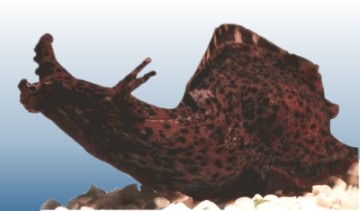
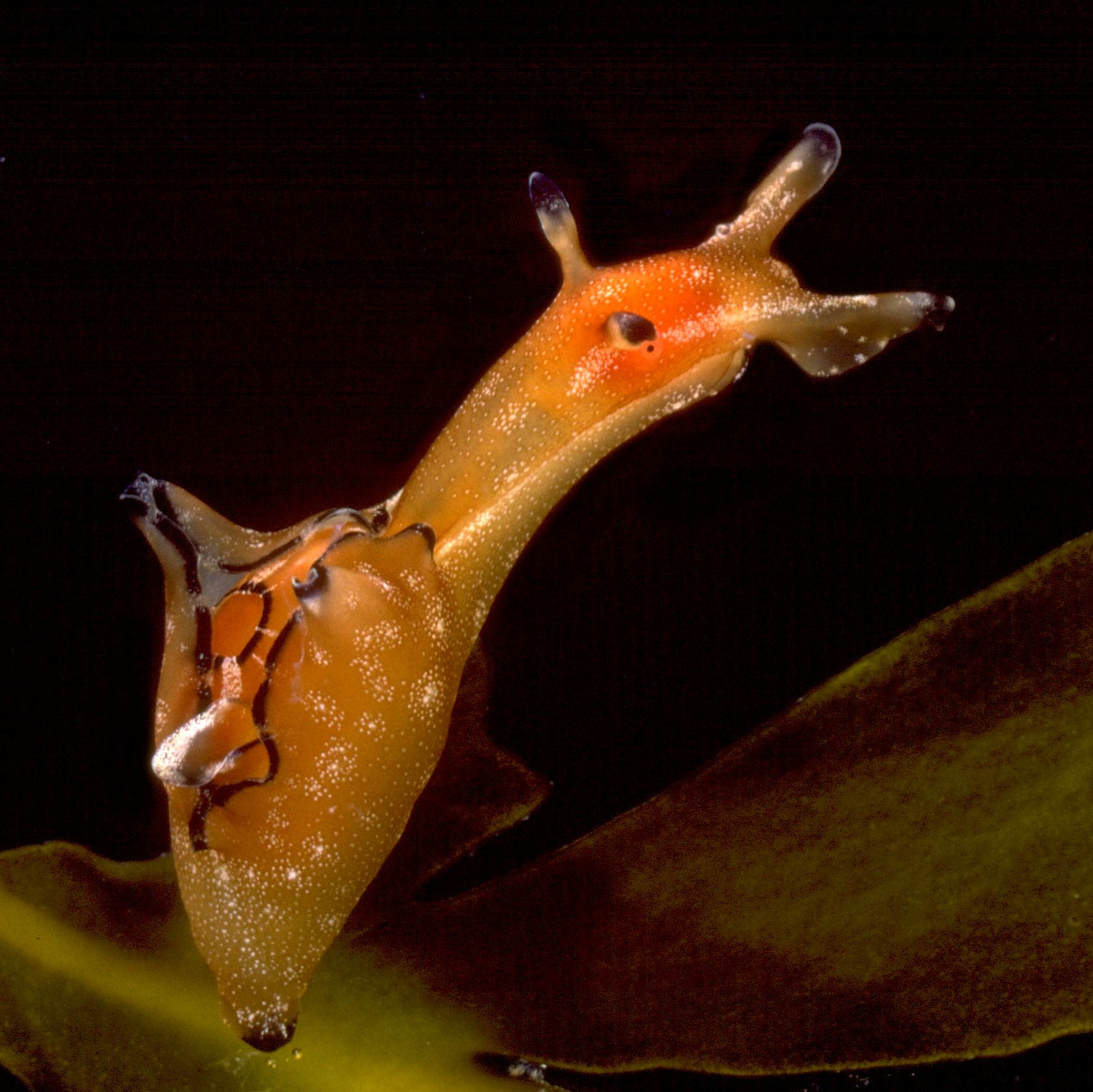
The following post about the chemistry of sea hare defenses was accepted into the Circus of the Spineless #5. [image follows]

Guess who described this creature about 150 years ago thusly:
During our stay, I observed the habits of some marine animals. A large Aplysia is very common. This sea-slug is about five inches long; and is of a dirty yellowish colour veined with purple. On each side of the lower surface, or foot, there is a broad membrane, which appears sometimes to act as a ventilator, in causing a current of water to flow over the dorsal branchiae or lungs. It feeds on the delicate sea-weeds which grow among the stones in muddy and shallow water; and I found in its stomach several small pebbles, as in the gizzard of a bird. This slug, when disturbed, emits a very fine purplish-red fluid, which stains the water for the space of a foot around. Besides this means of defence, an acrid secretion, which is spread over its body, causes a sharp, stinging sensation, similar to that produced by the Physalia, or Portuguese man-of-war.
None other than Darwin himself...in Voyage of the Beagle. The picture above is of Aplysia californica, a Sea Hare extraordinaire. Taxonomically, these critters belong to the class Gastropoda, order Anaspidea, superfamily Aplysioidea.

This cute little guy-girl (hermaphrodite) first made headlines in assisting researchers with understanding the chemical basis of memory and synapse response.*

Apylsia californica recently came to my attention via a study which revealed the chemistry of its defense mechanism, one which is reminiscient of the African bombardier beetle. As you may or may not know, this beetle mixes together peroxide and hydroquinones, which are compartmentalized, as a defensive spray. Unfortunately, creationists have often trotted this out as some sort of evidence against evolution, to the extent that it has become a PRATT.

This recent paper examined the defensive mechanism of the slug, which the quote above shows has been recognized as far back as Darwin's day, to elucidate the chemicals involved and their compartmentalization. The sea hare has both ink glands and opaline glands. The opaline glands produce a viscous substance with high concentrations of amino acids, and the ink glands are composed of three main vesicle types: red-purple, amber and clear. The chemical defense of the sea hares are contained within these vesicles, as well as the purple ink, which is derived from what the sea hare eats--algae. Muscles around the ink glands and opaline glands contract during a predation response, forcing the contents into the mantle together, the mixture of which then gets siphoned out.

The major contribution to the purple color in the ink (with other pigments present) is phycoerythrobilin. Although inking has its own defensive contribution, and although the predation response of ink and opaline had been investigated by some of the authors before (see Kicklighter, et al), the focus of this study fell upon a 60kDa enzyme which had been known to display antimicrobial activity, involved in the secretions. The concentration of this enzyme, escapin, in the ink-opaline mixture was found to be ~30 mM (keep in mind the small volume produced), well above the antimicrobial activity threshold.

The authors found that within the mixture of chemicals released by A. californica, those responsible for the antimicrobial activity included the L-amino acid oxidase, escapin, and targets Arg and Lys. Lysine is found at approximately 65 times higher concentration than arginine in the opaline secretions, while both R and K are found at approximately 1 mM in the ink, making it the major substrate. Furthermore, the authors remark that Lys is responsible for bacteriocidal activity, while Arg appears to only contribute to bacteriostasis. Escapin was only found to be present in the amber vesicles of the ink glands, and not found within any other tissues of the sea hare. It was known that escapin contributed to the lysis of sea anemone's tentacle tissue and symbiotic zooxanthellae at high concentrations, but at natural concentrations, its effect upon predators in this regard should be nominal.

The major compartmentalization is thus found between escapin and Lys. Escapin is present only in the ink glands, and the concentrations of Lys there are only 14-150 uM, while Lys is found at approximately 65 mM in the opaline glands.

In the discussion section, the authors conclude:
Significantly, lysine is packaged separately from escapin...Thus, the bioactive chemicals in this pathway are only produced when ink and opaline are mixed...This separate packaging of the enzyme from its substrates would aid in preventing autotoxicity within the animal before the vesicular release of the ink. Whether other L-amino acid oxidase toxins, such as those in venomous snakes, are packaged separately from substrates is, to our knowledge, not known.
So while in the bombardier beetle, two reactive chemicals are compartmentalized, what the authors have shown here is the compartmentalization of an enzyme and its substrate, which produce a defense mechanism for the sea hare.
The protein escapin has a highly restricted distribution across the tissues of the sea hare A. californica. The only tissue containing escapin is the ink gland; no other tissue or secretion contains escapin, not even those previously shown to have defensive chemicals, such as the opaline gland and skin. In addition, escapin is absent from the albumen gland of both sexually mature and immature animals. This is especially interesting because it contains aplysianin-A, a protein with 60% identity to escapin and with antimicrobial function.
This is another likely example of co-option, as escapin appears with one function [defensive] here, in its reaction with Lys for predator evasion, while the antimicrobial activity of escapin has been demonstrated previously, and likely existed in animals for this different function [immunoresponse]. The antimicrobial activity may have related to the release of these chemicals originally--to coat the skin with a thickening agent which would keep the escapin and substrates from diffusing away. The predation function would then be an obvious exaptation of the antimicrobial function.

Although beauty may be in the eye of the beholder, hopefully this ugly little bugger can warm your heart without squirting its escapin in your eye:


*Professor William Calvin has a nice write-up of the elucidation of memory in sea hares. Turns out that as long as 40 years ago, biologists recognized that these slugs were capable of learning, specifically, they habituate to repeated stimuli. But it took a lot of work to figure out that serotonin was responsible for influencing the synapses of their neurotransmitters to affect this habituation. The cascades were worked out painstakingly in an effort that led to much of our present understanding of neurochemistry.

iSpecies returns these results for Alpysia californica

References:
  1. Packaging of chemicals in the defensive secretory glands of the sea hare Aplysia californica. Derby, C.D., et al. Journal of Experimental Biology 209, 78-88 (2006)
  2. Sea Hares Use Novel Antipredatory Chemical Defenses. Kicklighter, C.E., et al. Current Biology 15, 549-554 (2005)
_______________
Technorati tags: , , ,

Wednesday, January 18

Wastewater Gumshoes

Your paranoid thought for the day: You'd better watch where you piss...if you are taking things you weren't prescribed. (update 3/08)

Karen Ross ties together some work by different analytical groups which clearly correlates the level of drugs found in wastewater to the populace producing the wastewater, via secondary metabolites. Analytical chemistry has been demonstrated to be able to take samples of local wastewater, determine pharmaceutical contents, and trace the drugs back to a source.

Given that each drug produces distinct metabolic products, many of which are not found in nature, the groups used analytical techniques to measure the amounts of these metabolites in wastewater and rivers. Determining a concentration gradient, where the amounts of drug increase as one hones in on the source, makes this exercise into detective work. Their work, so far, implicated cattle farmers for using steroids (the anti-asthma salbutamol) to induce growth in their stock. They have also found the levels of cocaine in the Po River (Italy) to correlate to about 7 doses per 1000 people per day, using an estimate of 5 million contributors.

If there ever becomes a law connecting the production of secondary drug metabolites to a crime (pissing out broken-down coke, marijuana, heroin, etc.), then those who use them ought to fear.

Extrapolating this to sampling local sewage systems would give police the ability to narrow down to neighborhoods, and, theoretically, individual houses, from which sources of secondary metabolites came. Legally, I can see no way to protect onesself from this sampling of wastewater. It is not an invasion of your privacy to catch the stuff you flush away...

As they say--you may be paranoid, but that doesn't mean they're still not coming for you.

References:
  1. Strategic Survey of Therapeutic Drugs in the Rivers Po and Lambro in Northern Italy . Calamari, D., Zuccato, E., Castiglioni, S., Bagnati, R., and Fanelli, R. Environ. Sci. Technol., 37, 7, 1241 - 1248, (2003). doi: 10.1021/es020158e
  2. Cocaine in surface waters: a new evidence-based tool to monitor community drug abuse. Ettore Zuccato , Chiara Chiabrando , Sara Castiglioni , Davide Calamari , Renzo Bagnati , Silvia Schiarea and Roberto Fanelli. Environmental Health: A Global Access Science Source 2005, 4:14. doi: 10.1186/1476-069X-4-14
  3. Drugs in the water. Karen Ross. Analytical Chemistry. 78, 1, 13, (2006). pdf

________________
Technorati tags: , ,

Pictures

If you're interested in some pictures of me, my wife Amber, and our dogs, here you go:

Common Misconceptions

I asked an old friend of mine, Crazilla, if he had anything interesting to say lately...and he sure did. The following are his thoughts, or you can view them at their original source:

Common Misconceptions, by Crazilla

FYI, in a spirited but lighthearted tone:

  • There is no "free trade vs. fair trade" conflict. Anyone with a conscience and an understanding of the term desires fair trade; from what i've gathered, its meaning is little more than literal. Free trade, on the other hand, has to do specifically with lessening the restrictive effects of legislation and taxation on the flow of resources, materials, products, labor, and capital across boundaries. It is opposed by many--but, it seems to me, supported, in concept, by many more--proponents of fair trade. The central problem with free trade seems to be that a product (or labor) that comes cheap from one source has the ultimate advantage over the corresponding products (or workers) from other sources of comparable quality, hence free trade undermines competition between sources of differing standards; for example, manufacturing plants in China that pay workers Jack Shit In A Can draw business from the U.S., which has become dependent upon low prices, and as a result businesses that pay U.S. workers decent salaries are sold out. (Overall, i see this as a positive effect of free trade; in the long run it will incite workers the world over to establish criteria of fairness which no company will be able to escape by simply changing location. This is a long way off, however.) Anyway, most advocates of fair trade seem to support relatively free trade on the condition of transparency. The popular myth that free trade and fair trade are opposing ideals seems, as far as i can tell, to stem from misleading reports that focus only on (apparently marginal) calls for balancing tariffs, which would merely serve to price foreign products similarly to domestic products; that is, establishing fairness for the companies in the eyes of the consumer (particularly the U.S. consumer)--the two most overprivileged entities in the trade system (far behind, for example, the farmers, laborers, and undeveloped governments). I obviously am very fresh on this subject, so any further suggestions for reading or thinking (and especially personal opinions) are encouraged.
  • You are a feminist. To some extent, you support fairness between (among?) the sexes and (nearly) equal opportunity for men, women, and whomever else in endeavors for which they're comparatively qualified. (If you read through the article, or at least this definition, and do not fit the description, I apologize; among my LJ friends i find no one known to me to oppose this concept. Speaking of which, what in blazes is the matter with you!?)
  • Everybody seems to like making fun of vegans. I kinda do, too--at least the ones who found their moral principles on the well-being of animals, particularly in an age when at least a quarter of people the world over are living on less than $1/day. However, it is important to note that many vegetarians and vegans care little (or, as in my case, not at all) for animals' so-called "rights" and humane treatment, and instead found the habit on the larger concern of sustainability--that is, they do it for the betterment of the world human population as a whole, and to better enable our species to fulfill its purpose of avoiding extinction and, in the meantime, to provide better living conditions to those without. However misguided you may feel some of these tactics to be, the cause itself is the noblest possible, and in any case meatless diets cause no one (except, in rare cases, the dieter) harm.

So, no one wants to join me for wine and cheese?

________________
Technorati tags: , , , , ,

Sunday, January 15

Flock of Dodos

Dr. Randy Olson, evolutionary ecologist (from Haaaavaad), has put together a documentary of sorts, covering the "Intelligent Design vs. Evolution Circus". From the documentary site's synopsis,
Dodos, rabbit poop, Mt. Rushmore and poker, what more could you ask for to make sense of the controversy of teaching intelligent design versus evolution. In the words of one Kansas School Board member, "It's really quite boring, isn't it?" Filmmaker and evolutionary ecologist Dr. Randy Olson tries to figure out exactly who is the flock of dodos.
Advanced screenings start Feb. 2nd in Kansas. God, I hope I can get a copy of this.

http://www.flockofdodos.com/

Also, go see DailyKO's installment of "Know Your Creationists"--this week, Dr. J Wells.
________________
Technorati tags: , , , , ,

Shawshank Sunday VI: Identity

The post will examine Aristotle's Law of Identity, Rand's extrapolation to her heroes, and Andy's redemption.

Identity encapsulates characteristics. Every man, we know, has a beating heart and thinking brain. The details, or quality, of these characteristics is specific to individual representations of an identity. All men have brains, but the brains of all men are not identical. Thus, all men have character, but the character of all men is individual.

Heraclitus once penned the famous, "Character is destiny". I will take this as a presupposition which simply predicts that cause-effect relationships determine "destiny," or at least those things which happen to an individual, the combination of things they can control and things they cannot. I will also take character to be a combination of virtues, contextualized to each individual. I will take identity to thus relate to the form of character--virtuous, unvirtuous, these will constitute the identity of the individual for my purpose here.

Ayn Rand used Aristotle's Law of Identity to build a foundation for rational self-interest. Her minor heroes (Francisco, Rearden, Dagny) exemplify this trait, but only her major heroes (Roark, Galt) display a near perfection of her Objectivism. While the former characters were at times plagued with personal flaws, doubts, emotions, fears...the latter were Rand's "Romantic Realism"--ideal characters projected onto real life situations. Rand's work has received criticism for its attempt to purvey her philosophy due to her inability to make her major heroes human, in many respects. Much like the Vulcan Spock, Galt and Roark are perfect Stoics, with Reason as their only driving force and guiding principle. These never display humanity--self-doubt, self-image issues, the need for outside approval, largely emotion in general. Although in Rand's work, the minor hero characters redeemed themselves, with the assistance of the major characters, who needed no redemption, Andy Dufresne is not depicted as a robot. He is also not perfect, or else there would be no Shawshank Redemption.

Andy was redeemed. Andy's redemption was not being freed from wrongful conviction, after all, he escaped and his name was never cleared.

In the vein of my earlier post on Andy's Stoicism, I want to argue that Andy was redeemed from the loss of his integrity. As he admitted, it took coming to prison to make him a dishonest man. He had never engaged in fraud or falsehood as a banker, but after wrongful imprisonment willingly participated in the Warden's corruption. Read the post for more detail.

The interesting thing is that Andy redeemed himself. No one else could. No one else would. Unlike Rand's minor heroes, who needed Galt/Roark (an archetype of a Savior), and unlike the uncorrupted Savior-figures of Roark and Galt, Andy both was corrupted and redeemed himself.

This is a beautiful component of the story, something that runs deep and deserves serious contemplation. King takes the unrealistic Randian hero, corrupts it, and gives it the power to redeem itself. Andy, like Spock, shows emotion and feels pain, but by the force of his will follows virtue to its logical conclusion. While Galt's identity is "The Guiltless Man", Andy's is not.

Andy feels guilt, but is compelled, of his own accord, to acheive the destiny his character has determined: redemption. Andy is "The Self-Redeeming Man". This is his character, his identity, and his destiny.
________________
Technorati tags: , , ,

Sunday, January 8

DNA Structure Investigation

I found an interesting post on histones. It brought to mind the work of Tullius, as I commented, work in which he has demonstrated a correlation between the 3D structure of DNA and function. By "mapping" the DNA using hydroxyl (OH "dot") damage (comparing patterns induced by this non-specific oxidant reveals surface domains, etc), then looking at the data for correlations to promoter regions, introns, metal-binding motifs, etc., Tullius' work is moving us towards a stronger understand of how the 3D structure becomes integral in function. As of now, developing an accurate 3D model from a simple sequence of DNA is rather difficult. The biophysical parameters, like roll, twist angle, clash between adjacent bases, are somewhat well described by certain models, but more accurate models are desperately needed. Incidentally, Tullius' work can also be correlated to the histones by simply rerunning the experiments using protein-bound DNA. Those patterns can then be matched against the sequences in contact with the histones versus the free DNA sequences, then correlations could be shown to DNA-binding proteins and metals based upon "histone availability" or some other such factor.

Admittedly, I guess I got a "crush" on the guy's work when he came and gave our inorganic division a seminar a little while back, and I got to have lunch with him.
________________
Technorati tags: , , , ,