Tuesday, January 30

"Brother Micah" and "Sister Elizabeth" Armstrong Descend and Defecate on UF

Meet "Brother Micah" and "Sister Elizabeth" Armstrong, originally of the Open Air Preaching Ministry of Miami. Micah was born April 20, 1967, and he's been an asshole ever since.

Micah and wife descended upon UF to spew forth their fear, ignorance and hatred for about 5 hours on 1/29 and 1/30, from 12-5, in Turlington Plaza. They may be back today. I'm quite unsure. Unfortunately, it looks like they're going to be regulars on the circuit now -- they teamed up with Jed and have already done a lot of touring of Florida campuses. See some Youtube videos of them on-campus at UF today (1/30) and yesterday here. Props to Adam for those.

The most noteworthy thing Micah has accomplished recently is getting an air horn set off right beside his ear by a strip club owner in Tampa last November. You can see the news article and videos here, and see video update (all it confirms is that Micah and Larry didn't press charges). How big of them [eye roll]. He and some Larry Keffer of the "Biblical Research Center" were the ones involved in the incident.

You can view lots of Micah's recent activities here, and this funny note by some rotten heathen that got posted to his site. Although the old webpage of the "ministry" is broken, you can see plenty of cached material via Google if you so desire, including Micah's views on judgment, run-ins with the homeless, run-ins with the Miami PD, and preaching at a Madonna concert last July. And, if you're interested, contact the owner of the domain moami.org -- Vera Berry, or visit the Miami Open Air Mission (or write them snail mail) at:
Miami Open Air Mission
14266 SW 176th Terrace
Miami, FL, 33177-0000
(305) 232-4173
Recently, Micah was assaulted at USF. I can't say I'm surprised. He's quite an asshole. Of course, I don't condone violence, but I am amazed that this man hasn't been beaten more severely already. I'm sure it would feed his martyr complex if it did happen.

While I enjoyed and was entertained by the spectacle of Brother Jed, and had decent rational dialogue with Tom Short, this Micah is just a bastard. (See my review of UF Campus Preachers: Part 1, Part 2) What I now realize is that my interactions with him just augment the crowd, and so I've decided not to stop by for long if I see him out there again. I don't mind having a big crowd when there's a real dialogue -- like with Tom or Jed. This loudmouth ass just uses volume control to drown out refutations, questions and corrections.

He made the UCF paper last semester, and there's a really good Myspace of him at UCF here. So that's USF, FAU, UCF and now UF. FSU, you're next!

You can see lots of their other Youtube videos here, most of them from FAU. My favorite part in that former (UCF) vid was when the girl told him, "Your preaching makes me so horny..." and put her tongue between her fingers. I about died laughing when he told her she was trying to seduce him. I wish I could embed it, but Myspace won't let you. Check it out here.

The second best of the Youtubes is prolly this one at FAU, which even got Digged. A young professor of literature there at FAU, Brian Spears, wrote this and this about Micah on FAU campus.

Here's my favorite video of Micah from UF -- the "It's not okay to be gay" song:

I saved the best one from the other campuses as a Youtube below:

Micah has now joined the "hall of shame" in my review of UF Campus Preachers: Part 1, Part 2.
________________
Technorati tags: , ,

Big Surprise

Sen. Brownback (R-Kansas), right-wing nutjob extrordinaire, re-introduced PERA yesterday. If you have Facebook, join this Facebook group opposing PERA. Last time, the religious right loon tried to attach PERA to a Veterans Appropriation Bill, a common tactic to slide shitty bills under the radar. See the AU for more on PERA.

Want to know just a bit about this cock-knocker Brownback? Well...
when [Pat] Robertson was asked on ABC's "This Week'' who he thought might make a fine Republican nominee in 2008, he began his answer: "There's an outstanding senator from Kansas ...''
Enough said. If Pat Robertson supports this guy for president, all rational people should run like hell the other way.
________________
Technorati tags: , ,

Monday, January 29

Videos of Brother Jed Smock at UF

Brother Jed (see my review parts 1 and 2) at UF giving us loads of entertainment as he banters on breasts, demonstrates the pedarasty of Michael Jackson with electrical extension cords, warns girls that they may end up "old hags" if they don't get some "marriage prospects" soon...and on and on. He was quite entertaining, to say the least. I look forward to his return to campus, as watching him was fun. See all 12 of these videos here.


Props to GF member Adam C. for this (and 11 more here)!
________________
Technorati tags: ,

Sunday, January 28

Credulity Demonstrated

At my school (UF), we have a "free speech zone" or two on campus that are heavily trafficked; campus preachers and student groups use them for advertising/proselytizing purposes on a regular basis -- especially Turlington Plaza. Brother Jed Smock had been on campus recently, so I went out to watch him for entertainment value a little on Thursday and Friday -- where I met a man who had a "free energy" device (FED). I and two other skeptics challenged him to demonstrate this marvelous supernatural device, and he did.

Long story short, he brought this little fan-driven motor to my lab bench and asked me to test the batteries connected to it with a voltmeter. Then, he started it turning (he input mechanical energy) and let it go on for a long time. The fan was kept running by the batteries connected to the motor. The key is, one of the batteries was running the motor against the resistance, while the other battery was supposed to be charged at a rate greater than the first battery's depletion!

Afterwards, I tested the batteries and found that the voltage reported was actually higher than before he started. What I should've realized at the time was the energy he input was far greater than the resistance the fan encountered. Voltage is not energy. But at the time, I told him I was a bit confused. I adamantly declared his idea of a FED was nonsense, but I told him I'd have to go home and think over how his device generated more voltage in the battery. Also, I should've made him stay there for more than 4 minutes.

The difference in the energy put in (when he started the motor by spinning the fan) versus put out would've become quite clear as the fan eventually slowed and stopped. The initial turn of the fan's rotor put in exactly as much charge into the batteries as they lacked, as this was the load on the motor.

Basically, the guy ran Bedini's "School Girl Experiment":


First, when you click the link of the schematic above, you see that this guy is spouting off complete and utter nonsense:
On this slide, we show a theoretical scheme which several researchers have discovered and used to build simple free energy motors. In this scheme, we drive an ordinary d.c. series motor by a two wire system from an ordinary battery. The motor produces shaft horsepower, at -- say -- some 30 or 40 percent efficiency, compared to the power drained from the battery. This much of the circuit is perfectly ordinary.
The trick here is to get the battery to recharge itself, without furnishing normal power to it, or expending work from the external circuit in the process.

To do this, recall that a charged particle in a "hooking" del-phi river moves itself. This is true for an ion, as well as for an electron. We need only make the del-phi in correct fashion and synchronize it; specifically, we must not release the hose nozzles we utilize to produce our del-phi river or waves.

The inventors who have discovered this have used various variations, but here we show a common one. First, we add an "energizer" (often referred to by various other names) to the circuit. This device makes the del-phi waves we will utilize, but does NOT make currents of electron masses. In other words, it makes pure Ø-dot. It takes a little work to do this, for the energizer circuit must pump a few charges now and then. So the energizer draws a little bit of power from the motor, but not very much.
WTF? Anyway, the technical take-down of all FEDs based on this sort of scheme can be found here by Eric Krieg. Krieg is like the James Randi of "over unity device" skepticism.

Now, if this sounds familiar to my long-time readers, they may recall that I mentioned a company called Steorn using similar technology/concepts as the aforementioned device. I said at the time not to hold your breath waiting on a demonstration, and...whattya know? I was right!

The fellow at UF with the earthshatteringly-important FED is named Rick Friedrich. Rick runs truthinheart.com, specializing in publication of various obscure titles in theology...and overunity electronic technology developed by John Bedini and Tom Bearden. His page describing John Bedini's new book (that he has published) alludes to the details of the devices that supposedly defy the 1st and 2nd laws of thermodynamics (LoT). John had these details up on a web page, now archived here, that includes scans of the patents he received and shows the schematic diagrams for these devices.

Although his credentials appear to have come under some scrutiny, Bearden's work got published (somehow) in an obscure journal. You can read his scans of the article here at his site. Probably the funniest thing from the article is the circular references -- he says that his results have been independently verified by "Naudin", and supports this with an endnote [2]. Go to reference 2, and you find the words, "Communicated in Ref. 1". Hilariously, reference 1 is quite difficult to even understand, but claims a paper by Bearden himself, in Adv. in Chem. Phys. 114. This is a print-on-demand book selling for $245. Not exactly an easy reference to check, but the table of contents doesn't mention Bearden or any of his co-authors.

Basically, if something sounds too good to be true, it is.

See here for a skeptical investigation into a similar bunch of nonsense perpetrated by Dennis Lee.
________________
Technorati tags: , , , , , , , , --

Friday, January 26

"Left Behind" Video Game Sales Disappoint; Company Stock Plummets

Boy, I just hate it for them. Considering all the efforts to organize boycotts by religious groups, typically due to intolerance of one form or another; this time, voices of reason against intolerant and religiously-motivated depictions of violence have been heard:
...not only do media reports coming out of Southern California reveal that the game has received mediocre sales, but a simple look at Left Behind Games Inc (LFBG) stock performance — in the words of DefCon advisory board member and Christian Alliance for Progress director Rev. Tim Simpson “you didn’t think this was a ministry, did you?” — reveals over an 80% drop in the stock’s price since the game was released in November.
Sweet. Violent video games "for God" suck.
________________
Technorati tags:

Pew Poll Finds Large Drop in God-belief in "Gen. Next"

One-in-five members of Generation Next say they have no religious affiliation or are atheist or agnostic, nearly double the proportion of young people who said that in the late 1980s. And just 4% of Gen Nexters say people in their generation view becoming more spiritual as their most important goal in life.
Check out the details here, and some analysis here.
________________
Technorati tags: , ,

Thursday, January 25

HBO Special Airs Tonight: "Friends of God"

"Friends of God", a documentary by Alexandra Pelosi (Nancy's daughter) including interviews with Ted Haggard (before his fall from grace), Jerry Falwell, and other Evangelical leaders, airs tonight on HBO at 9 PM. Americans United has more.

If someone could Tivo this and send it to me, I'd pay them for their trouble.

HBO Synopsis: (link)
With her unique brand of road-tripping reportage, and driven by an unflagging curiosity and genuine interest in learning about this increasingly influential community, Alexandra Pelosi (whose previous HBO credits include 2000's Emmy®-winning "Journeys with George") embarks on a fast-paced cross-country journey, offering snapshots of a cross-section of evangelical America in Friends of God: A Road Trip With Alexandra Pelosi.

A sassy one-woman show who directs and shoots from the driver's seat, Pelosi ventures out over a year-long period for up-close and personal encounters with some influential members of the evangelical community, from Joel Osteen, the most-watched TV minister in America, to pastor Ron Luce, the founder of "Battle Cry," a concert tour that has drawn more than two million young people to its events nationwide. Pelosi also visits with a spectrum of others who embody a wide range of evangelical experiences, among them visitors at religion-themed parks, a Christian comic, creationist educators, Liberty University students and activists in Washington, D.C.

In her slice-of-life exploration, Pelosi travels to the red states and beyond to meet an array of open and forthright evangelicals who represent a broad sampling of the community. Many are pro-life and against gay marriage, and believe in a literal interpretation of the Bible, rebuking Darwinism.

Among them is Pastor Ted Haggard, who recently stepped down as president of the 30-million strong National Association of Evangelicals - the largest evangelical group in the U.S. - following allegations that he had sex with a male prostitute and bought illegal drugs. Before the scandal broke, Haggard welcomed Pelosi to his world, explaining that an evangelical is "a person who believes Jesus is the Son of God, the Bible is the Word of God, and that you must be born again." While mega-churches like his New Life Church in Colorado Springs have replaced the quaint churches of yesteryear, Haggard explains that their sense of community is as strong as ever and this contributes to evangelicals' happy lives.

Says Haggard, "We've settled the issue of eternal life. The Bible is clear about it...we are not afraid of death because of it. We are living in the United States of America; we have representative government; and we have freedom of religion and freedom of the press." He asks, "Why in the world would a person in that environment not be happy?"

During her journey, Pelosi also visits with Rev. Jerry Falwell, leader of The Moral Majority and chancellor and founder of Liberty University in Lynchburg, Va., who articulates a commitment to change the country and urges his congregation to "vote your values" in elections. "Evangelicals are the largest minority block in this country," he says. "It's not a majority, but I don't think you can win without them. John Kerry learned that. Al Gore learned that. And Hillary will learn that in 2008."

Alexandra Pelosi began her career in TV covering politics in Washington, D.C., and subsequently served as a network news producer for seven years. For her first film, 2000's Emmy®-winning HBO documentary "Journeys with George," she spent 18 months on the campaign trail with future president George Bush. For the 2004 HBO documentary "Diary of a Political Tourist," she spent a year and a half following seven Democratic presidential candidates, including John Kerry, Joe Lieberman and Howard Dean. Pelosi is the daughter of California congresswoman Nancy Pelosi, who becomes the first female Speaker of the House in history next month.

FRIENDS OF GOD: A ROAD TRIP WITH ALEXANDRA PELOSI was written, directed and produced by Alexandra Pelosi. For HBO: supervising producer, Lisa Heller; executive producer, Sheila Nevins.
________________
Technorati tags: ,

Barack Obama '08

Obama slams the asshats at FauxNews for lying. How many times has bullshit been reported by the spin doctors at that channel, and later proven as bullshit? Anyone who watches that channel pretending to be getting objective, well-researched and documented news is a dumbass.

Show your support for Barack Obama by joining his database and giving him a little sum-sum here. I just put $25 in Barack's coffers; I wish the election was tomorrow. I'm just twiddling my thumbs, waiting to put in my vote for him. Hillary is a spineless hack. She panders too much, is too moderate and has too little conviction.
________________
Technorati tags:

Wednesday, January 24

Wall Street Journal Article on Religious "Healing Remedy" Frauds

From the WSJ: There's a sucker born every minute. Unfortunately.
________________
Technorati tags: ,

On the Virtue of Fortitude

I noticed I had a link from an old friend, and so I just had to investigate, of course.

CalvinDude is upset at me for not getting what he, and other presups, have so patiently tried to tell me a million times: that the Problem of Evil is dead! The whole Euthyphro Dilemma doesn't apply! He admits that good isn't contingent upon what God says, so I can't catch him on that horn.

Why can't I just get it?

Things aren't good because God wills them that way, or says they are -- instead, goodness is grounded in God's own nature! I mean, "God's nature" is, somehow, some way, supermagicalistically transcendentally disconnected from this dilemma...how can you not get that? Well, all I can conclude is that CalvinDude possesses more fortitude than I, plus I'm stupid, I guess.

Before I paste my response comment, let me say that I appreciate his attempt to extricate God from the Euthyprho Dilemma and to rescue Divine Command Theory from intellectual bankruptcy. I will not promise, though, to deal with this issue more fully myself in the future. I think enough philosophers have spilled enough ink already to see the major problem -- either morality transcends the question of God's own existence (and thus God's nature as well, and whatever would dictate said nature), or it doesn't and it is contingent upon some aspect of God's existence.

This latter clause is the horn Divine Command Theorists are impaled on, and the former clause destroys the argument that God is necessary for, or ontologically serves as, the "foundation" of morality. It's pretty simple to me -- either / or. Now, here is my comment, and if people want to read more on this (the PoE in general, plus Euthyphro's Dilemma), I will have to just tell you to check out some books from the library, because I am too tired and busy to deal with it any further; I just don't have the fortitude (or the spare time + lack of marriage + lack of social life) of the average presuppositionalist, it appears:

sdanielmorgan Says:

I didn’t respond to your later critiques [of Prof. Witmer's paper] due to other priorities at the end of the semester, not out of dejection.

I still haven’t gotten around to sitting down and dealing with a lot of hardcore philosophical issues, because at the moment I’m in the middle of a hardcore chemistry Ph.D. oral candidacy defense. I have, however, made photocopies of some good stuff from Armstrong on universals, including one article called, “Can a Naturalist Believe in Universals?” I also read a book called, “Whatever Happened to Good and Evil?” That lays out a solid case for ethical objectivism and refutes the sort of God-contingent morality you laid out above.

Armstrong’s case I find quite compelling — he argues that particulars have the causal power to “create” universals. His argument is that universals do not have some sort of causal power to instantiate particulars, but vice versa. This really helped me to conceptualize universals a little better (not necessarily that now, I do so quite well) because what plagued me was in imagining something outside of space and time instantiating anything. What is instantiation? An action? A causal connection? How does it interact? This same problem would bother me if these universals were supposedly inside of God’s mind, or whatever. The argument is “Universals arise from particulars, and not the other way around.” And for whatever reason, this is a pill I can better swallow.

It’s a kind of standard issue for any sort of dualism — how do things of different elemental substances interact? How could they cause or affect one another? And these sorts of open-ended questions exist for the theist and the atheist. Saying that, because morality has an intrinsically non-time-space-matter-contingent character (just as logic and mathematical truths and other abstracta do), that this necessitates a Person to nicely “account” for these things.

First, I will tell you that I do not accept the logical validity of any form of relativism or subjectivism. Either good and evil are real properties, just like red and round, or they are not. Our perception of them does not make them so. Neither does God’s. Either logic and mathematical truths and morality constrain the nature of reality (including God’s own definitions), as well as what and who God can be and is, or those things somehow become a contingency of God’s existence, which is not possible. You seem to try to avoid contingency by making a sort of “parallel” argument, but I don’t have the time to deal with it right now.

I will only comment here to say that I don’t buy into “God’s morality” and “man’s morality”. You almost sound like a relativist with such statements. There is only good and evil — transcending personhood. Either moral properties exist, or they do not. Either moral propositions are true, or they are not. They are not made real/true by God’s existence, and virtual/false by God’s nonexistence. Equivalent to, “2+2=4,” so, “Causing harm for fun is evil,” does not depend on God in any way. It is the nature of reality — it is logically necessary…what evil is, and what good is, not what God makes them or what God is.

As Prof. Witmer said in his interview with Gene Cook — it is the nature of what it is to be evil to cause harm for fun. It is a real property of that state of affairs (causing harm for fun). It is the nature of what it is to be good to alleviate suffering whenever possible. In the same way that 2+2=4, it is foundational, self-evident and incorrigible, and it matters not one iota whether God exists or not to make it true. That’s my situation. I stop there. The regress ends there for me.

To me, the sort of person who requires justification for those propositions is the same as the person who says, “But why is blue darker than yellow?” I cannot bring myself to waste time in trying to justify it.

One reason I stopped arguing much with you guys is that you only have one weapon in your arsenal: the one Sextus Empiricus developed long before the days of Jesus — the regress argument. Presuppositionalists want to use the classical regress arguments to destroy the foundation of anyone’s knowledge; excepting, of course, propositions like “God exists,” and “God is all-good, all-powerful…” as valid foundations. But the sort of skepticism you advocate is colored — to the degree you apply it, it undermines the validity of others’ presuppositions. But, you cannot maintain the same degree of global skepticism without self-refuting; turning that skepticism inward on yourself will leave you in the same boat as me.

I haven’t dealt with epistemology as I plan to — I have had one presuppositionalist recommend the book, “Longing to Know” to me as a good one to start out with as a primer on Christian views on epistemic problems. I take certain beliefs for granted, and I would argue strongly that others do too, for the simple reason that they are justified by my own experience and their intuitive, self-evident quality.

For me, armchair philosophy is a hobby, and I really do enjoy it. But, I lose myself sometimes in it, and neglect other things (like getting my Ph.D. finished). It is very hard to be very good at chemistry and at philosophy. Maybe some people can do it; perhaps they have more brilliance or time, or both, than I do.

Anyway, for me this is a sort of process, not some search for a “magic bullet” argument to convince me about God one way or the other. The problem of evil is the single argument that I think renders theism irrational; I would be agnostic if it weren’t for the PoE. If I could find a real solution to it, I’d drop back to agnosticism, rather than believing that the conception of God as all-good and all-powerful is illogical, given the existence of evil. Anyway, I miss our chats, but I also enjoy my newfound productivity. One day, I’ll really try to get around to your latter responses to Prof. Witmer.

I like the new look of the blog.

Best,
D

I thought this long comment worth sharing. I would add that global, unrelenting skepticism falls on its own sword. You can't know what you can't know. But you know that you exist, you know that logic is valid, that 2+2=4...and you cannot make yourself not believe certain things. Plus, the regress problem is typically approached by looking at epistemology -- coherentism and classical foundationalism.

I'm tired. Fortitude is developed this way, they tell me.
________________
Technorati tags: , , , ,

Sen. Jim Webb, (D) VA

I wanted to share this video of new Senator Jim Webb, from my home state, responding to the SotU. I think it worth your time to check out the 10-min YouTube; or, get the .flv file.

________________
Technorati tags:

Tuesday, January 23

Interesting Church-State Separation Cases

From Prof. Friedman and Prof. Byrd come two cases of interest to me: one for personal reasons; the other out of curiosity.

Curiosity first: the 5th Circuit Court is hearing a case involving a monument in Harris County, TX, which recently had neon lighting installed to highlight a Bible therein (no, I'm not joking). You can read some background on it here. Oddly, the county went ahead and removed the monument, apparently hoping to moot the case, just days before the case begins arguments at the 5th C. The BJC filed an amicus brief in the case. See here and here for more.

The personal case revolves around Teen Ranch, an outfit strongly resembling Teen Challenge, with which I have personal familiarity. The 6th Circuit Court has upheld a lower court's ruling which allows a state agency to prevent boys from being sent to the Christian facility. See Prof. Friedman's posting for details, and Teen Ranch's side of the story archived here. It appears that their site is down for good -- perhaps their legal fees and such have caused them to sacrifice the domain. One has to wonder how the federal funds going to such organizations will continue once the Dems start to revamp the whole "faith-based initiative" mess. Perhaps the Dems won't tackle it. For the sake of our country's future, I hope they do.
________________
Technorati tags: ,

Sunday, January 21

COTG #58

The 58th edition of the Carnival of the Godless is up at Abe Linkum.
________________
Technorati tags: , , ,

Saturday, January 20

Insect Evolution

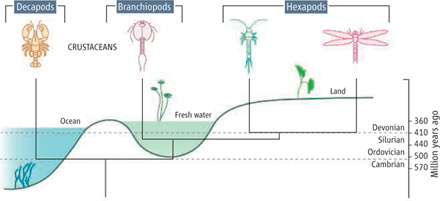
Hexapod evolution. The last common ancestor of hexapods and crustaceans (branchiopods, specifically) may have originated in freshwater during the Late Silurian, giving rise to extant freshwater dwelling branchiopods (fairy shrimps, water fleas, and tadpole shrimps) and insects. This hypothesis accounts for the missing fossil record of branchiopods and hexapods before the Devonian. (Fig. 1, Glenner, et al., Science 22 December 2006: Vol. 314. no. 5807, pp. 1883 - 1884)

I've always been fascinated by the subject of insect evolution. People with even a rudimentary appreciation for detail will have noted some of the similarities between certain insects and crustaceans -- the sort of exoskeletons and segmentation they possess, for one thing. However, although scientists have known that there is shared ancestry between the groups, hard transitional fossils for insects have never been found. Now, new morphological and genetic research (Hox) indicates that insects may not be cousins with crustaceans, sharing a common ancestor, but may have actually originated within the clade, most closely related to branchiopods. Below the fold, I am pasting in the full-text of a recent Science article (Glenner, et al., Science 22 December 2006: Vol. 314. no. 5807, pp. 1883 - 1884) giving perspective on six papers detailing the genomic relationships among these groups:

__________
Science 22 December 2006:
Vol. 314. no. 5807, pp. 1883 - 1884
DOI: 10.1126/science.1129844

Perspectives
EVOLUTION:
The Origin of Insects
Henrik Glenner, Philip Francis Thomsen, Martin Bay Hebsgaard, Martin Vinther Sørensen, Eske Willerslev

Although hexapods--those arthropods having six legs, including insects--are the most diverse group of contemporary animals in terms of biological niches and number of species, their origin is highly debated. A key problem is the almost complete absence of fossils that connect hexapods to the other major arthropod subphyla, namely Crustacea, Myriapoda (such as centipedes and millipedes), and Chelicerata (such as scorpions and spiders). Over the years, hexapods (insects, springtails, proturnas, and diplurans) have been phylogenetically linked to all of these major arthropod taxa (1). [see Fig. 1 at top of post]

Traditionally, hexapods and the multi-legged myriapods have been united in a group named Atelocerata on the basis of morphological similarities between their tracheal respiration systems and head appendages. However, recent evidence from phylogenetic analyses of molecular sequence data from a variety of genes, as well as from newer morphological studies, points to a relationship between hexapods and crustaceans (2-9), a grouping commonly referred to as Pancrustacea. Furthermore, studies on neurological development in the major arthropod groups have pointed out similarities between the myriapods and chelicerates (10). Hence, pancrustacean monophyly seems to be gaining more support. So, what does this view tell us about the possible origin of hexapods?

The crustaceans are recorded at least as far back as the Upper Cambrian, about 511 million years ago (11), where they are found in marine sediments (see the figure). However, except for the debated Devonohexapodus bocksbergensis specimen (12, 13), all hexapod remains are found only in freshwater or terrestrial strata no earlier than the Devonian, around 410 million years ago (14). This leaves a gap of 100 million years to the earliest crustaceans. The common explanation has been that earlier traces of hexapods have been erased from the fossil record and that hexapods, like other major groups of terrestrial animals, have closely related ancestors to be found in the marine environment.

The recent morphological and molecular-based studies suggest an alternative interpretation--that hexapods originated within the crustaceans rather than as a sister group (15-20). Although the morphological studies mainly favor a close phylogenetic connection between hexapods and malacostracan crustaceans (crabs and crayfish) (15, 16), recent molecular sequence data suggest that hexapods are closely related to branchiopods (17, 19, 20), a freshwater dwelling group of crustaceans that includes water fleas and fairy shrimp. This hypothesis is supported by analysis of Hox genes that demonstrates homology between development of the pregenital trunk region in insects and the thorax in branchiopods (21). The new molecular results correspond well with the fossil record and suggest an evolutionary origin of the hexapods in freshwater around 410 million years ago rather than in the marine Cambrian environment (17).

The vast majority of extant branchiopods are freshwater animals, and the few that are found in saltwater are believed to have invaded the sea secondarily. From the fossil record, it is known that modern branchiopods date back to the Early Devonian, by which time they were fully adapted to freshwater habitats (22). This late appearance of the freshwater branchiopods corresponds exactly with the emergence of hexapods and suggests that their last common ancestor swam around in a freshwater pond sometime in the Late Silurian (423 to 416 million years ago) or Early Devonian. This corresponds well with the time split between the crustacean and hexapod lineages estimated from molecular clock analyses (23). If correct, the early marine ancestor of the hexapods might have appeared more similar to Rehbachiella kinnekullensis, a close marine relative to branchiopods from Upper Cambrian (24), than to D. bocksbergensis or other hexapods.

The successful colonization of the terrestrial environment by hexapods seems to coincide with other major groups of land pioneering animals such as the chelicerates and the myriapods in the Late Silurian and the tetrapods (amphibians, reptiles, birds, and mammals) in the Late Devonian. All these events appear to have occurred through a freshwater dwelling phase in their evolutionary transition from marine to true terrestrial animals. The Devonian is believed to have been a time of severe drought, which might have forced these animals (at least hexapods and tetrapods) onto land as their freshwater habitats vanished.

It has been a puzzle as to why hexapods--in particular insects, which possess a morphology that apparently enables them to adapt to virtually all types of terrestrial environments--have not been able to diversify successfully in the marine environment. It is likewise remarkable that the crustaceans--fulfilling a biological role in the sea comparable to the insects on land--have not been able to invade land to a greater extent despite their considerable age. The recent phylogenetic analyses of molecular sequence data suggest a paradigm shift concerning the phylogenetic position of hexapods--that crustaceans successfully invaded land as insects. It is possible that when insects entered terrestrial habitats, their crustacean ancestors had already diversified in marine environments and occupied all potential niches, which could explain why insects were prevented from colonizing the sea subsequently. Most important, however, the new molecular results offer a solution to the enigma concerning the absence of marine hexapod remains in the fossil records prior to the Devonian.

References and Notes
  1. G. Giribet, C. Ribera, Cladistics 16, 204 (2000).
  2. J. M. Mallatt et al., Mol. Phy. Evol. 31, 178 (2004).
  3. J. C. Regier, J. W. Shultz, Mol. Phy. Evol. 20, 136 (2001).
  4. J. W. Shultz, J. C. Regier, Proc. R. Soc. London Ser. B 267, 1011 (2000).
  5. U. W. Hwang et al., Nature 413, 154 (2001).
  6. G. Giribet et al., Nature 413, 157 (2001).
  7. C. E Cook et al., Curr. Biol. 11, 759 (2001).
  8. Y.-x. Luan et al., Mol. Biol. Evol. 22, 1579 (2005).
  9. W. Dohle, Ann. Soc. Ent. France 37, 85 (2001)
  10. H. Dove, A. Stollewerk, Development 130, 2161 (2003).
  11. G. E. Budd et al., Science 294, 2047a (2001).
  12. F. Hass et al., Org. Divers. Evol. 3, 39 (2003).
  13. R. Willmann, Org. Divers. Evol. 5, 199 (2005).
  14. M. S. Engel, D. A. Grimaldi, Nature 427, 627 (2004).
  15. S. Harzsch, Integrative Comp. Biol. 46, 162 (2006).
  16. N. J. Strausfeld, Arthropod Struct. Dev. 34, 235 (2005).
  17. J. C. Regier, J. W. Shultz, Mol. Biol. Evol. 14, 902 (1997).
  18. C. E. Cook, Q. Y. Yue, M. Akam, Proc. R. Soc. London Ser. B 272, 1295 (2005).
  19. J. C. Regier et al., Proc. R. Soc. London Ser. B 272, 395 (2005).
  20. J. Mallatt, G. Giribet, Mol. Phy. Evol. 40, 772 (2006).
  21. M. Averof, M. Akam, Nature 376, 420 (1996).
  22. S. R. Fayers, N. H. Trewin, Trans. R. Soc. Edinburgh Earth Sci. 93, 355 (2003).
  23. M. W. Gaunt, M. A. Miles, Mol. Biol. Evol. 19, 748 (2002).
  24. D. Walossek, Fossils Strata 32, 54 (1993).
  25. This work was supported by The Danish Natural Science Council, The Velux Foundation, The Carlsberg Foundation, and The Wellcome Trust.
__________

But remember: evolution is just a fairy-tale. All this "research" is really just a vast Darwinian conspiracy. Intelligent Design Creationism explains this stuff so much better! Nonetheless, it's fascinating stuff; to think about how much sense this makes, and how well-supported the evidence is, that Devil sure is tricky, eh?
________________
Technorati tags:

Bye-Bye "Dr." Dino! Kent Hovind Gets 10 Years in Prison

Kent Hovind's prayers apparently fell on deaf ears. The Pensacola News Journal reports:

10 years for 'Dr. Dino'
Michael Stewart
mstewart@pnj.com


Pensacola evangelist Kent Hovind was sentenced Friday afternoon to 10 years in prison on charges of tax fraud.

After a lengthy sentencing hearing that last 5 1/2 hours, U.S. District Judge Casey Rodgers ordered Hovind also:

-- Pay $640,000 in restitution to the Internal Revenue Service.

-- Pay the prosecution’s court costs of $7,078.

-- Serve three years parole once he is released from prison.

Hovind’s wife, Jo Hovind, also was scheduled to be sentenced. Rodgers postponed her sentencing until March 1 to allow her defense attorney an opportunity to argue possible discrepancies in sentencing guidelines.

Prior to his sentencing, a tearful Kent Hovind, also known as "Dr. Dino" asked for the court’s leniency.

“If it’s just money the IRS wants, there are thousands of people out there who will help pay the money they want so I can go back out there and preach,” Hovind said.

Hovind, founder of Creation Science Evangelism and Dinosaur Adventure Land in Pensacola, was found guilty in November of 58 federal counts, including failure to pay $845,000 in employee-related taxes. He faced a maximum of 288 years in prison.

Jo Hovind was charged and convicted in 44 of the counts involving evading bank-reporting requirements and faces a maximum of 225 years in prison.

Kent Hovind, who is incarcerated in the Escambia County Jail, will be assigned to a prison by the Bureau of Prisons. Rodgers recommended Kent Hovind be sent to the prison at Saufley Field in Pensacola so he will be close to his family.

It will be up to the Bureau of Prisons, however, to make that determination.
Sorry you pathetic con man, but "thousands" of suckers can't bail you out this time by sending you checks.

I guess there is some justice in the universe, after all. (HT: Pharyngula)
________________
Technorati tags: , ,

Friday, January 19

YouTube Recommendations

  1. Le Grand Content: Simply Hilarious.

    "Le Grand Content examines the omnipresent Powerpoint-culture in search for its philosophical potential. Intersections and diagrams are assembled to form a grand 'association-chain-massacre'. which challenges itself to answer all questions of the universe and some more. Of course, it totally fails this assignment, but in its failure it still manages to produce some magical nuance and shades between the great topics death, cable tv, emotions and hamsters."

  2. Mr. Deity

    • Part 1: "Mr. Deity and the Evil" -- "After creating the universe, Mr. Deity and Larry go over 'The List' to see what kind of evil will be allowed"

    • Part 2: "Mr. Deity and the Really Big Favor" -- "Mr. Deity seeks help to save mankind while Larry continues construction efforts."

    • Part 3: "Mr. Deity and the Lighting" -- "Mr. Deity and Larry have trouble with the lighting on their new world."

    • Part 4: "Mr. Deity and the Messages" -- "Mr. Deity explains prayer to Jesus while Larry gathers info on the evening's activites."
________________
Technorati tags: , ,

An Informal Look at the Problem of Evil

I keep meaning to write an in-depth look (*update* DONE) at the Logical Problem of Evil (PoE), as compared with the Evidential Problem of Evil (see here for a good exposition of the EPoE), but I can't seem to find the time to give it the treatment it deserves. However, I got an email recently from a Christian creationist directing me to look at a recent interview with Francis Collins, in which he is asked questions related to the PoE. The following is my response; keep in mind that "you" used below refers to a Christian creationist:
_____
Since you brought up the question of scientists and creation, I'll analyze his interview. The National Geographic interview you're referring to was with Francis Collins and John Horgan? I read it, and I read the Time interview between Collins and Dawkins.

Francis Collins was the head of the Human Genome Project, and his new book is called, "The Language of God: A Scientist Presents Evidence for Belief" (LINK) -- he is an ardent supporter of evolutionary theory. If anything, his words should mean more to you than to me, since you have the belief that proponents of the scientific theory of evolution are all atheists; that educated Christian scientists, who accept the authority of science over the authority of the Hebrew creation story, like Collins aren't possible. You seem to think that evolution is some sort of conspiracy among godless heathen professors, but you would have to include people like Collins in that conspiracy.

Anyway, the most meaningful issue that they touched on in this recent National Geographic conversation, IMHO, is the Problem of Evil. It is an ancient argument, and I find it devastating to the concept of an omnibenevolent and omnipotent God. I would be agnostic if it were not for the PoE.

Collins' response to Horgan on the PoE:
Horgan: Many people have a hard time believing in God because of the problem of evil. If God loves us, why is life filled with so much suffering?

Collins: That is the most fundamental question that all seekers have to wrestle with. First of all, if our ultimate goal is to grow, learn, and discover things about ourselves and things about God, then unfortunately a life of ease is probably not the way to get there. I know I have learned very little about myself or God when everything is going well. Also, a lot of the pain and suffering in the world we cannot lay at God's feet. God gave us free will, and we may choose to exercise it in ways that end up hurting other people.
Collins ignores the fact that some suffering brings about no "learning" whatsoever -- suffering that leads to death, animal suffering, senseless random acts of natural disaster...and that this sort of pain and suffering would lead many to learn that this is evidence of either: i) a callous God, ii) a weak God, or iii) a non-existent one.

Collins also ignores the responsibility of God in giving free will. This is a very important distinction, and one that most Christians ignore -- they assume that God almost has to give people free will in every situation, and that this is better than God restricting human freedom during horrible circumstances.

Consider: most parents would agree it is not more loving to allow their young child to freely hurt themselves and others than to step in and stop them. The parent would even be held liable in a court of law for negligence. But why is it that God is somehow supposed to be exonerated from responsibility for giving people free will to abuse and use however they want?

Consider: many babies are born with fatal diseases, and/or acquire leukemia at a very early age. Would it be more loving, or less loving, for God to have allowed Hitler to be one of those babies? Would it be more loving, or less loving, for God to restrict Hitler's freedom? The answer is obvious. And thus, the PoE destroys the capacity for a believer to say that it is rational to believe in a God who is all-loving and all-powerful.)
Horgan: Physicist Steven Weinberg, who is an atheist, asks why six million Jews, including his relatives, had to die in the Holocaust so that the Nazis could exercise their free will.

Collins: If God had to intervene miraculously every time one of us chose to do something evil, it would be a very strange, chaotic, unpredictable world. Free will leads to people doing terrible things to each other. Innocent people die as a result. You can't blame anyone except the evildoers for that. So that's not God's fault. The harder question is when suffering seems to have come about through no human ill action. A child with cancer, a natural disaster, a tornado or tsunami. Why would God not prevent those things from happening?
Collins ends with the very sticky open question for believers. It isn't just a matter of "having enough trust"; it is a logical question of how one can reconcile the notion of God's goodness with the notion of natural evils.

Blaming the devil doesn't work: God supposedly created the devil, so this just pushes it back a step further.

Handing it off to "free will for the devil" also doesn't work, because, as I explained above, it is not "all-good" and "all-loving" to give someone/something power or the will to do evil with, when you could instead restrict that power/will.

Consider: humans cannot fly. We never think much about things this way, but if you believe in God, then you agree that God has restricted your free will -- often times you wish you could just fly away like a bird. The very complex topic that this opens up leads some people to believe in Calvinism/determinism, because they recognize that intrinsically, we often will to do something that we cannot accomplish.

Imagine, for instance, that I want to win the 100-meter race. I simply do not have the genetics for it, period. I could put all of my heart and soul into it, but never could I beat out natural athletes whose bodies are marvelously fit for such exercises. In the same way, my Saint Bernards will never attack a child and maul it to death. Both of these two things are related: my physical nature limits me (by genetics), and so does theirs. People are no more "free" than their bodies and natural inclinations make them, and thus not truly free at all.

Philosophers have dealt with this topic extensively, and they point to the source of our will as desire, and the source of our desire as our nature -- and so the question of what constitutes our nature becomes relevant. No one can deny that genetics hugely constitutes our nature, as well as how we are raised. Children who are abused will deal with pain and anger for their entire lives that, for instance, I will not. We all know people who seem to have been born with a gentle nature -- completely nonviolent. It takes much more to anger them than the average person. Let's call that person, "Ms. X". If she is raised in a loving home and well-educated, it is completely unlikely that she will ever feel the urge to cause someone terrible pain for fun. Why is it that Ted Bundy enjoyed causing pain for fun? As a scientist, I want to study his brain, his genes, and his environment as a child -- three things he had no real control over (he wasn't free to determine those things), and compare his to "Ms. X's".

I would bet the ranch that I could find something physically different between Bundy's physiology and hers. She simply never felt the desire to harm people that he was constantly bombarded with. That desire came from an unhealthy brain. She feels a degree of empathy that compels her to help people in need and in pain. He feels no empathy whatsoever. Who is ultimately responsible for how Bundy's brain works? For his lack of empathy? For his innate desire to harm others? I would answer: it is a random part of genetics and chemistry -- variation occurs naturally in these processes, we observe it all the time. You get an entire spectrum of traits from nature: good and bad. You would answer...?

Now, Collins wants to argue that God cannot intervene in human affairs. First, Collins ignores the serious issue I laid out above: who set the laws of chemistry and biology in motion, if God does exist? And if God made the laws in such a way that they would produce a Ted Bundy, could God not also have affected those same laws such that everyone was born with the personality of Ms. X? And if God could, would God not want to? If both...then why do Ted Bundy's exist?

Consider: everyone could've been born with the gentle nature of a Saint Bernard, and it is logically possible that no "Yorkshire Terrier"-type angry personality existed. If that is possible, then God has an obligation to bring about the highest good for the highest number of people. If that is not what we observe (and we obviously don't), then either: i) God isn't able, ii) God isn't willing, or iii) God doesn't exist.

Collins argues that God cannot intervene because of chaos...but, God could intervene in such a way that we wouldn't even know it was happening. Some examples I just outlined above -- i.e. that Hitler was born with a crippling disease, or that people are born with a high degree of empathy and compassion, and no urges to hurt people for fun. Another problem for Collins are simple examples of senseless suffering -- like when lightning starts a forest fire and humans, deer and squirrels get burned alive and die a horrible frightened death. If the lightning never struck that particular tree, would the world be "very strange, chaotic, unpredictable"? Or would we never have known any differently?

The same scenario could apply to most human behaviors -- i.e., a person gets up and is a great mood, and doesn't want to go abduct a child that day, because God has altered their desires such that they do not feel violent. Would they know that? Or would they just go about their business, whistling and happy? If one believes that drugs can alter the state of mind to affect human emotions, moods, and desires, then why is it not possible for God to do the same?

Again, God doesn't "get off" for giving unrestricted free will to people who will abuse it -- it represents negligence on the part of whomever gives someone power that will be abused when they know ahead of time that it will, and could otherwise stop it. And, if while this person was sleeping, I injected them with some Xanax or anti-psychotic, they would wake up feeling different desires, and not even know why. If I knew that this person would wake up with the desire to abduct and rape a child, and I had the power to affect this desire, and make it go away, I would. Not only would I, but I would be morally evil if I did nothing! Now, in the same sense, God not only has the power to affect this person's desires, but according to believers, God is in control of everything!

Therefore, God is ultimately responsible for the configuration of the pedophile's brain that makes them lust after children. There is no part of me that lusts after an innocent child, nor of most mentally healthy people. Pedophiles are mentally ill, and is it more reasonable to believe that a loving God made them that way, that God doesn't intervene to make them mentally health...or that God doesn't exist? I find it more rational to believe in the last option.
Horgan: Some philosophers, such as Charles Hartshorne, have suggested that maybe God isn't fully in control of his creation. The poet Annie Dillard expresses this idea in her phrase "God the semi-competent."

Collins: That's delightful—and probably blasphemous! An alternative is the notion of God being outside of nature and time and having a perspective of our blink-of-an-eye existence that goes both far back and far forward. In some admittedly metaphysical way, that allows me to say that the meaning of suffering may not always be apparent to me. There can be reasons for terrible things happening that I cannot know.
There could indeed be. But, what would Collins have to do to the term "all-good" and "all-powerful" in order to allow for these sorts of reasons?

Consider: Many Christians use this sort of defense, or a soul-making theodicy, to try to say that God uses evil to bring about good. An analogy is often drawn to the very young child at the dentist's, where the child is undergoing pain and does not understand that the dentist is not evil, nor are the parents for taking the child to the dentist. However, the failure of this analogy is simple: if God is all-powerful, then God could bring about this good in another way. If the parent were powerful enough to choose between: i) giving the child fluoride in the water to prevent their tooth-related issues and, ii) letting the child develop those issues, and then go through pain to fix them, then we would say that any parent who chose (ii) over (i) was evil. Now we might say that our conception of good and evil is flawed to try to rescue this, or our understanding of God is, but then we sabotage the very definitions that we ascribe to God.

On the issue of "there could always be a morally compelling reason for God to allow evil", then, we might stop and think for a moment. There could indeed also be purple unicorns floating through the universe. Let us grant, for a moment, that both are logical possibilities. But we cannot believe on such speculations. We can only judge truth by what we know. We are not being rational if we ignore the evidence in front of our face in order to dream up scenarios on how things might otherwise be.

Furthermore, I do not think it possible for an all-good and all-powerful God to be trapped into this sort of situation, like the kid at the dentist above, and God being compelled somehow to choose (ii) over (i). In the analysis of what those "omni" terms mean, I do not comprehend how God could ever be "cornered" in this way -- forced to choose to allow evil. In the first place, God never has to create anything, or do anything, if God is all-complete and perfect. Therefore, it seems to follow logically that this option is always available to God, and therefore, God could never be compelled to do anything whatsoever.

If we say that the notion of God must make suffering and evil different for God, then we lose the right to call God "good" for the same reason. That is, if we say, "What seems evil to us may not be evil to God," then the same thing applies to, "What seems good to us may not be good to God." And if this is true, then things like compassion, charity, kindness, self-restraint, patience, tolerance...those things are good to us. How can we say God is/has those things? If what is good to us isn't real, or doesn't represent God's view, then why do we call God "good" at all?

If allowing and causing gratuitous pain, suffering, and misery isn't evil, then we lose the basis for calling things (or God) good as well. However, no reasonable person can deny what is good and evil. It is an intrinsic part of our human nature to feel compassion, altruism, empathy...we cannot pretend we do not. And we call those things, "good". Furthermore, the moral properties we ascribe to actions, behaviors, and character based on our intuitions and perceptions are real. If they were not, then there is no such thing as morality. If no real moral properties exist, then no good and evil exist. If no good and evil exist, then God still doesn't exist! (Remember that the definition of God includes goodness.)

We must use our conceptions and perceptions of good and evil as the only basis for those things, elsewise we lose any grounding for using the terms at all. Ergo, if there is a God who does not feel those things as we do, nor act on those things as we would, why would we call this God "good" at all? We can't logically make those characteristics square with the sort of God who would introduce, allow, or even possibly make the sorts of evil that we all observe and experience.

Collins has ignored the depth and breadth of this devastating argument against theism.

Therefore, the PoE leaves us with this (rearranged from Epicurus):
P1) The gods either can take away evil from the world and will not
P2) or, being willing to do so [take away evil from the world] cannot
P3) or, they [gods] neither can nor will [take away evil from the world]
P4) or, they are both able and willing [to take away evil from the world].
C1) If they have the will to remove evil and cannot, then they are not omnipotent. (if P2)
C2) If they can, but will not, then they are not omnibenevolent. (if P1)
C3) If they are neither able nor willing, then they are neither omnipotent nor benevolent. (if P3)
C4) Lastly, if they are both able and willing to annihilate evil, how does it exist? (this is a reductio ad absurdum for P4)
The only rational answer is -- all-powerful and all-good gods do not exist. And, if some other form or version of God exists: say, a weak one; or a morally ambivalent one...then does it deserve our acknowledgment, respect, or adoration? No. Could we be morally obligated to a God which has less compassion than we do? Less power to prevent evil? After all, we are the ones being forced to cure cancer and eradicate starvation.

And that is why I am an atheist, not an agnostic, with respect to a "tri-omni" God of goodness, knowledge and power. I do not believe in such a Being for good reason. I cannot logically discount other sorts of gods -- weak ones or morally questionable ones, but I also cannot believe in them, nor would I care to know one way or the other about them.
________________
Technorati tags: , , ,

Wednesday, January 17

Hold on to Your Hats!

**UPDATE: Here's the promised update. The news report was right -- it's now 5 mins till. Here is a press release on why...[yawn]**

Okay, that's sarcasm. I am referring to the "big announcement" coming at 9:30 AM EST (in 15 mins) from The Bulletin of Atomic Scientists, who manage the Doomsday Clock. They have created a little suspense with their announcement that, "[we] will launch a new website and have a major announcement" this morning in a conference. This news article claims to have inside information that the clock will be set to 5 mins till midnight. Big deal. The Clock has been a lot closer, and has little insight as to whether or not nuclear arms are already available on the black market.

I'll be updating this story shortly (in about 10 mins, I guess).
________________
Technorati tags:

Thoughts on Marriage (Gay and Otherwise)

All over the news today is a recent poll confirming that there are more single women today than married women. Is this the "crumbling" of the "institution of marriage"? I think not. And if it is, then it is clear that gay marriage is not [yet] able to be blamed. I often hear a rational attempt at an argument against gay marriage coming from its antagonists. That doesn't mean that the attempt = a success, of course. I also hear/read a little humor from the protagonists poking at these arguments.

Some of the most common lines of reasoning have been outlined and responded to, and so I don't want to rehash those here. What I do want to do is use a few statistics, a recent news article and a recent op-ed in the NY Times for some thought-provocation.

I really do understand a lot of social conservatives' fears about gay marriage. I don't feel it, myself, and I have something that they seem to lack (a sense of unmitigated compassion, desire for complete equality and justice...) -- a healthy anti-religious bias. That is, I am biased against arguments merely based upon the presumption of divine revelation, and I require more: arguments from law, humanistic morality and pure reason (sans "God said...").

A lot of conservatives look at what they call the "moral decay" of our society, and they think that marriage is a sort of "last bastion" into which they can retreat and fend off the growing secularization of the country and weakening religious influence ... geez, I have to stop and uncross my eyes even as I write that. Anyway, these sorts of people really see our country in that way -- that there is a violent culture war and marriage is a last stronghold to defend against its enemies. Of course, since these "enemies" are a part of culture itself, then this view has to hold that those persons are destroying their own society. If these people really believe this, then I understand them, and can even sympathize, to a degree. Because then they have a good point about one thing: if indeed marriage slides into oblivion (as it may already be doing), then our society will be irreversibly changed. Most people would think this change would be for the worse -- fewer children born, fewer stable homes and households to raise them in. The real problem is the non sequitur between (1) gay marriage and, (2) the downfall of/attack upon/decline of marriage in culture.

First, without overstating the obvious, gay marriage is another type of marriage. It therefore cannot logically be a reduction in the number of married people, but it must represent an increase in the number of married people. Ergo, the burden on the shoulders of anti-gay opponents is to show how "marriage suffers" [sneer quotes due to the reification fallacy, and anthropomorphic nature of such sentiments]. The op-ed below points out that marriage has been trending down for a very long time in our country, without a legal union between same sex couples.

Why is that?

There are conservatives with concerns about this, and who realize you can't blame gays for the major issues facing the family. After reading an atheist conservative refer to the high percentage of out-of-wedlock births among African-Americans and Hispanic-Americans, it somewhat reawakened me to the reality that there are some people who are nonreligious that are fretting over marriage -- and that they may have reasonable cause (versus those armed with only religious fear). Her stats were simple, bleak, and to the point: 70% of black babies, and 46% of latino babies, are born to unwed parents in America today. I confirmed her stats, and in fact, they are a little low by the last major census look. Her argument is that poverty is strongly correlated to teenage and unwed births [although not always]. This is logical and straightforward -- kids require financial support, and thus going to college and getting a good job become less feasible for teens and for single parents. This is indeed a worrisome trend, because it would represent a serious impediment for this socioeconomic sector to overcome in order to move upwards on the financial ladder. The question I have is: what does gay marriage have to do with this? Is this not about the availability and encouragement of birth control and protected sex?

Another cultural factor to consider is the trend observed with birthrates divided along political lines, [joke: some might argue along IQ lines as well]. The argument here is that the more liberal our society becomes, the less babies they have. Therefore, conservative views are correlated to (whether they cause or not) higher birthrates. But the picture is complex, as illustrated aptly in this '04 The American Conservative article, and modern young liberals may not reflect the same trend as their parents' generation. Consider that at Berkeley, typically agreed as one of the (if not the single) most liberal public campus in the USA, there is no major difference in family planning:
Asked to rate how important an array of different goals was to them personally, the biggest group of 2004 Berkeley freshmen chose "raising a family" as essential or very important, 70.9%. That's just a few percentage points less than the 2003 national average: 74.8% of all U.S. freshmen felt similarly about raising a family.
It is thus easy to make hasty generalizations about what liberalization, or gay marriage, impact in terms of our culture. However, it seems that liberal, conservative, straight and gay all experience the same humanity, with its desire to engage in loving, committed relationships and raise children. If that part of the equation were focused on a bit more, perhaps we'd all bicker a bit less.

I would still like to see more empirical data to convince me that the trends of marrying later in life and having fewer children are in any way impacted by gay marriage. I simply don't buy the rhetoric, and think the logic is bogus. Our culture has been trending this way for a long time, without legal gay marriages. The op-ed below examines this trend, and offers some advice for opponents of gay marriage.
November 7, 2006
Too Close for Comfort
By STEPHANIE COONTZ

Olympia, Wash.

EVER since the Census Bureau released figures last month showing that married-couple households are now a minority, my phone has been ringing off the hook with calls from people asking: “How can we save marriage? How can we make Americans understand that marriage is the most significant emotional connection they will ever make, the one place to find social support and personal fulfillment?”

I think these are the wrong questions — indeed, such questions would have been almost unimaginable through most of history. It has only been in the last century that Americans have put all their emotional eggs in the basket of coupled love. Because of this change, many of us have found joys in marriage our great-great-grandparents never did. But we have also neglected our other relationships, placing too many burdens on a fragile institution and making social life poorer in the process.

A study released this year showed just how dependent we’ve become on marriage. Three sociologists at the University of Arizona and Duke University found that from 1985 to 2004 Americans reported a marked decline in the number of people with whom they discussed meaningful matters. People reported fewer close relationships with co-workers, extended family members, neighbors and friends. The only close relationship where more people said they discussed important matters in 2004 than in 1985 was marriage.

In fact, the number of people who depended totally on a spouse for important conversations, with no other person to turn to, almost doubled, to 9.4 percent from 5 percent. Not surprisingly, the number of people saying they didn’t have anyone in whom they confided nearly tripled.

The solution to this isolation is not to ramp up our emotional dependence on marriage. Until 100 years ago, most societies agreed that it was dangerously antisocial, even pathologically self-absorbed, to elevate marital affection and nuclear-family ties above commitments to neighbors, extended kin, civic duty and religion.

St. Paul complained that married men were more concerned with pleasing their wives than pleasing God. In John Adams’s view, a “passion for the public good” was “superior to all private passions.” In both England and America, moralists bewailed “excessive” married love, which encouraged “men and women to be always taken up with each other.”

From medieval days until the early 19th century, diaries and letters more often used the word love to refer to neighbors, cousins and fellow church members than to spouses. When honeymoons first gained favor in the 19th century, couples often took along relatives or friends for company. Victorian novels and diaries were as passionate about brother-sister relationships and same-sex friendships as about marital ties.

The Victorian refusal to acknowledge strong sexual desires among respectable men and women gave people a wider outlet for intense emotions, including physical touch, than we see today. Men wrote matter-of-factly about retiring to bed with a male roommate, “and in each other’s arms did friendship sink peacefully to sleep.” Upright Victorian matrons thought nothing of kicking their husbands out of bed when a female friend came to visit. They spent the night kissing, hugging and pouring out their innermost thoughts.

By the early 20th century, though, the sea change in the culture wrought by the industrial economy had loosened social obligations to neighbors and kin, giving rise to the idea that individuals could meet their deepest needs only through romantic love, culminating in marriage. Under the influence of Freudianism, society began to view intense same-sex ties with suspicion and people were urged to reject the emotional claims of friends and relatives who might compete with a spouse for time and affection.

The insistence that marriage and parenthood could satisfy all an individual’s needs reached a peak in the cult of “togetherness” among middle-class suburban Americans in the 1950s. Women were told that marriage and motherhood offered them complete fulfillment. Men were encouraged to let their wives take care of their social lives.

But many men and women found these prescriptions stifling. Women who entered the work force in the 1960s joyfully rediscovered social contacts and friendships outside the home.

“It was so stimulating to have real conversations with other people,” a woman who lived through this period told me, “to go out after work with friends from the office or to have people over other than my husband’s boss or our parents.”

And women’s lead in overturning the cult of 1950s marriage inspired many men to rediscover what earlier generations of men had taken for granted — that men need deep emotional connections with other men, not just their wives. Researchers soon found that men and women with confidants beyond the nuclear family were mentally and physically healthier than people who relied on just one other individual for emotional intimacy and support.

So why do we seem to be slipping back in this regard? It is not because most people have voluntarily embraced nuclear-family isolation. Indeed, the spread of “virtual” communities on the Internet speaks to a deep hunger to reach out to others.

Instead, it’s the expansion of the post-industrial economy that seems to be driving us back to a new dependence on marriage. According to the researchers Kathleen Gerson and Jerry Jacobs, 60 percent of American married couples have both partners in the work force, up from 36 percent in 1970, and the average two-earner couple now works 82 hours a week.

This is probably why the time Americans spend socializing with others off the job has declined by almost 25 percent since 1965. Their free hours are spent with spouses, and as a study by Suzanne Bianchi of the University of Maryland released last month showed, with their children — mothers and fathers today spend even more time with their youngsters than parents did 40 years ago.

As Americans lose the wider face-to-face ties that build social trust, they become more dependent on romantic relationships for intimacy and deep communication, and more vulnerable to isolation if a relationship breaks down. In some cases we even cause the breakdown by loading the relationship with too many expectations. Marriage is generally based on more equality and deeper friendship than in the past, but even so, it is hard for it to compensate for the way that work has devoured time once spent cultivating friendships.

The solution is not to revive the failed marital experiment of the 1950s, as so many commentators noting the decline in married-couple households seem to want. Nor is it to lower our expectations that we’ll find fulfillment and friendship in marriage.

Instead, we should raise our expectations for, and commitment to, other relationships, especially since so many people now live so much of their lives outside marriage. Paradoxically, we can strengthen our marriages the most by not expecting them to be our sole refuge from the pressures of the modern work force. Instead we need to restructure both work and social life so we can reach out and build ties with others, including people who are single or divorced. That indeed would be a return to marital tradition — not the 1950s model, but the pre-20th-century model that has a much more enduring pedigree.

Stephanie Coontz, a history professor at Evergreen State College, is the author of “Marriage, a History: How Love Conquered Marriage.”
I think this lack of social networking may be a problem in some geographies and some socioeconomic classes. One would think, though, that is this were some panacea for marriage, that churchgoers would be significantly less likely to divorce, since much social networking occurs at church. But, Barna has shown this not to be the case.

Although there are some studies which purport to show some protective effect for couples who spend time together praying and attending church regularly, I have argued before in the comments of this post at DC that this confuses the symptom with the disease. The study used to support this notion doesn't take into account all couples, church-attendees or not, who spend some regularly-scheduled and disciplined time together, and engage in activities together due to common interests. One can certainly argue that this latter rationale explains the apparent "protective effect" -- for any faith group, and for even non-faith groups. That is, the fact that you are spending regular time together, and participating in regular activities together -- whether religious in nature or playing golf together -- is a sign of a healthy relationship, and not the cause thereof.

In the end, it may be that the landscape of marriage is forever and irreversibly changed. The forces behind this change may include the empowerment of women and economic pressures disallowing single-parent working homes. A simple solution, and blaming a single factor (like gay marriage), only exposes the naïveté of the one proposing it. The real solution to the decline of marriage may be solved via natural selection -- those who value marriage and childrearing will simply outnumber those who do not bear children, eventually, and values tend to propagate downward through family generations.
________________
Technorati tags: , , ,